Scientific status · October 2026

Separate what works from what remains unknown.

Transference is deliberately developing a scientific boundary around its ambition. Each capability is classified by present evidence and engineering status, while external research enters through an authenticated but untrusted evidence path.

Transference Research · public programme

Inquiry that continues.

We investigate artificial intelligence, cognition, neuroscience and human–machine systems through persistent scientific inquiry. Our public record will distinguish evidence from inference and hypothesis, document uncertainty, and show when a conclusion changes.

Science autonomy · active within defined research boundaries

Autonomy of inquiry is not autonomy of authority. Research outputs remain subject to provenance, contradiction checks, evidence requirements and human-principal review before promotion into trusted knowledge.

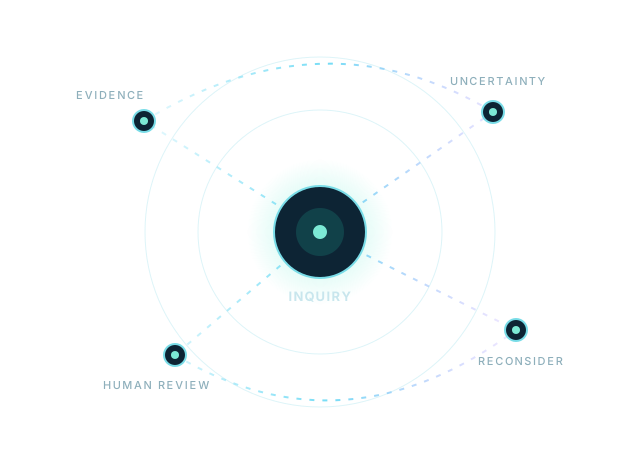
An inquiry linked to evidence, uncertainty, reconsideration and human review
Research process illustration · not a live system readout
Public research record

Research publications

Stable identifiers, evidence states and revision histories will make each published result traceable. The mission ledger below records verified activity; publications explain selected research outputs. They serve different purposes.

TER-0001 · proposed inaugural report

Autonomous scientific cycles: activation and initial verification

Methods, observations, limitations and provenance will be published after the first eligible cycle and its records have been reviewed. Activation alone is not evidence of scientific discovery.

In preparation
TRN

Research notes

Focused observations and open questions.

TEM

Evidence maps

What evidence supports, disputes or leaves unresolved.

TH

Hypotheses

Testable propositions with explicit uncertainty.

TER

Experimental reports

Methods, results, limits and follow-up tests.

TRC

Reconsiderations

Changes to earlier positions and the reasons for them.

TSR

Science reviews

Longer synthesis across a research question.

Existing scientific papers and standards remain available in Transference Science papers. This new publication register will grow as individual records pass review.

Scientific claim status

How to read a claim

The A–D classification below describes capability maturity. These labels describe the evidence for an individual scientific claim. A demonstrated software capability can still investigate an open hypothesis.

Established evidence

Supported by strong, independently checkable evidence in the relevant field.

Supported inference

A reasoned conclusion from evidence, with assumptions stated.

Open hypothesis

A proposition awaiting decisive tests.

Speculation

Exploratory idea without sufficient support.

Unsupported or falsified

A claim the available evidence fails to support or weighs against.

Research domains

Questions across disciplines

Autonomous scientific inquiry joins the five established expert gateways below. These domains describe research questions, not claims that the long-term aims have been achieved.

Autonomous scientific inquiryNeuroscienceBrain–computer interfacesCognitive modellingApplied cryptographyDistributed systems

Autonomous inquiry question: How can a persistent research system revisit its conclusions without treating its own generated claims as independent evidence?
A / B / C / D status grid

Capability classification

These classes describe the present Transference programme. They are not grades of scientific disciplines and do not imply that long-horizon hypotheses have been demonstrated.

A
Demonstrated in the current system

Authenticated research transport & governed intake

  • Dual Sensorium evidence ingestion foundation
  • Multi-agent TNR research missions
  • HMAC-SHA256 signed research envelopes
  • Verified transport into quarantine
  • Idempotent bridge retrieval and explicit human-sovereignty contracts
B
Engineering prototype

Measurable cognitive fidelity

  • Hash-chained cognitive provenance design
  • Novel-scenario Experiment Engine
  • Recall, preference, calibration and decision-alignment metrics
  • Contradiction / duplication gates before research promotion
  • Requires continued deployment validation and repeated human experiments
C
Research frontier

Higher-fidelity human representation

  • Experimentally stronger cognitive models
  • Non-invasive neural signals as supplemental context
  • Remote embodiment and telepresence
  • Principal-controlled cryptographic identity and recovery
  • Distributed cognitive reconciliation across many nodes
D
Long-horizon hypothesis

Continuity beyond the biological presence

  • Subjective continuity in a digital instantiation
  • Consciousness transfer or duplication
  • Biological replacement / cloned embodiment hypotheses
  • Interplanetary proxy embodiment as a continuation model
  • No present claim that these capabilities are achieved
Epistemic architecture

Two evidence lanes. One human authority.

Local Sensorium evidence and outside research have different trust boundaries. The HMAC envelope applies to the external TNR lane; it does not make research claims true.

Private / personal evidence lane
Sensorium→Evidence + provenance→Cognitive model→Human correction

Personal evidence remains inside the private Transference trust boundary and is attributable to source and principal review state.

External research lane
TNR research→HMAC envelope→Verify signature→Quarantine→Human/private review→Trusted knowledge

Transport authenticity proves that a payload crossed the expected signed boundary. Epistemic trust still requires review, contradiction checks, provenance and controlled promotion.

Human-sovereignty rule: no external research item is automatically promoted into trusted cognitive memory merely because it was signed, generated by an AI system, or scored with high confidence.

Methods & governance

Make the process inspectable.

Selected public records should show what was asked, which evidence was examined, what remains uncertain, why a position changed, and whether a human approved publication.

Publication record

Each artifact will carry an identifier, date, domain, claim status, source references, methods, limitations, revision history and system or human attribution. A public ledger receipt may be linked when appropriate without exposing private payloads.

Reconsideration record

A revision will identify the previous position, new evidence, trigger, revised position and remaining uncertainty. Negative and inconclusive outcomes belong in the record as well.

TNR transparency

Cryptographic mission ledger

The public ledger publishes only SHA-256 mission hashes and aggregate counts from locally verified quarantined mission records. It intentionally excludes mission text, private context, HMAC secrets, signatures and research payloads.

Read-only proof surface

Verified mission receipts

Loading ledger…

Retrieving public mission receipts…

Expert invitation gateways

Five communities can materially accelerate the work.

We are not asking collaborators to validate extraordinary claims. We are inviting domain experts to help design tests, identify failure modes and improve the evidence boundary.

N

Neuroscience

What measurable variables contribute to stable individual decision identity over time?

Discuss neuroscience →
B

Brain–computer interfaces

Which present non-invasive signals could augment a cognitive twin without implying thought decoding?

Discuss BCI →
C

Cognitive modelling

How should decision fidelity between a person and a computational representation be experimentally measured?

Discuss modelling →
K

Applied cryptography

How can the human principal remain the ultimate authority while devices, agents and credentials remain replaceable?

Discuss security →
D

Distributed systems

How should a cognitive representation reconcile conflicting observations from multiple Sensorium nodes?

Discuss architecture →
Research collaboration

Challenge the architecture with evidence.

Transference benefits from criticism that turns assumptions into experiments. If your work intersects cognition, neurotechnology, cryptography, distributed systems or human–AI delegation, start a research conversation.

Evidence-led programme updates

October 2026 research expansion

Programme directory

Research Programmes

Transference connects autonomous scientific inquiry with empirical neuroscience, computational cognition and experimental engineering.

Dated register

Research and Engineering Milestones

Public milestones are recorded with their verification scope and limits, rather than treated as proof of broader scientific conclusions.

Research status describes the evidence available for each activity. Public content does not disclose private cognitive records, raw neural recordings or authorization details.