01
Persistent context
Approved project history, preferences, knowledge and decisions accumulate instead of being rebuilt from scratch.
Transference is building a persistent personal intelligence layer that can learn from your approved knowledge and decisions, coordinate trusted AI agents, and extend your ability to act — while the human remains the highest authority.
AI is moving from answering questions to taking action. Transference focuses on the missing layer: persistent identity, context, memory, authority and accountability tied to the individual the agents represent.
Approved project history, preferences, knowledge and decisions accumulate instead of being rebuilt from scratch.
The system progressively models how its principal communicates, reasons, prioritizes and delegates.
Specialized agents can work within bounded authority and return evidence, decisions and exceptions for review.
Personal intelligence becomes infrastructure that can persist across devices, applications and time.
The long-term architecture treats the human principal as the root of identity, intent, authority, memory ownership, delegation, revocation and recovery. Devices, local Sensorium nodes and agents are subordinate execution and observation layers — replaceable, auditable and revocable.
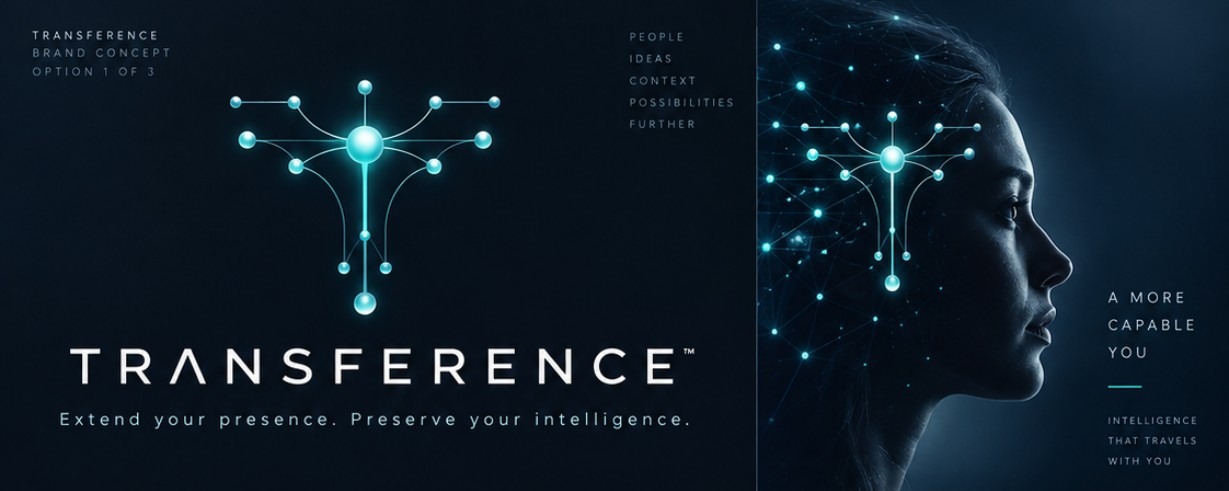
Transference's ultimate research ambition is not limited to a better AI assistant. We intend to investigate whether progressively richer representations of a person's knowledge, memories, values, decision patterns and — as neural interfaces mature — relevant neural information could support a persistent digital continuation of mind.
Capture and organize enough context to create useful continuity across projects, decisions, devices and agents.
Preserve increasingly rich aspects of memory, judgement, values and reasoning so a digital representation can remain useful over long periods of time.
Explore whether future AI and neural-interface systems could support a substantially richer digital instantiation of an individual, including applications where biological presence is impossible or impractical.
Scientific boundary: Transference does not claim that subjective consciousness can currently be uploaded, transferred or duplicated. Whether a digital instantiation could preserve subjective continuity or constitute the same person remains an open scientific and philosophical question. The project treats that uncertainty as a research problem, not as a solved fact.
Transference separates what is working now from what is still research. A far-horizon goal is not presented as a present capability.
People can join because the idea resonates. Transference needs users, researchers, developers, critics, partners, storytellers, investors and ordinary supporters willing to help a difficult idea become real.
Join the public list for build updates, research notes, demonstrations and future early-access invitations.
Make a one-time project support contribution through PayPal. Support helps fund development infrastructure, testing, research and public demonstrations.
Start a private, non-binding conversation around strategic investment, research collaboration, infrastructure, distribution or long-term partnership.
Choose the relationship that fits you. There is no purchase requirement and no commitment.
Early participants can influence how Transference handles delegation, trust, memory, privacy, continuity and the boundary between human authority and machine execution.
This form begins a private conversation only. It is not an offer to sell securities, a solicitation to invest, or a promise of future returns.
Transference can openly pursue radical long-term goals without pretending that unresolved scientific questions have already been answered.
Yes — as a far-horizon research ambition. Transference ultimately aims to investigate whether an increasingly complete representation of an individual's mind could exist in a digital state or another computational embodiment. This is not a capability the project claims to possess today.
No. Present work concerns cognitive modelling, memory, identity, delegation and continuity. Whether subjective consciousness can be digitally preserved, transferred, duplicated or instantiated remains unresolved.
That is one of the deepest unresolved questions around identity and consciousness. A system might reproduce memories, reasoning and behaviour without proving continuity of subjective experience. Transference treats this distinction as central research territory.
Transference is built around an information-and-computation path: preserve and progressively enrich the structures that make an individual's knowledge, agency and decision-making useful. It is not dependent on cryogenic preservation or any particular biological-preservation strategy.
Potentially, in the far horizon. A sufficiently capable digital continuation could allow a person's knowledge, judgement and delegated agency to operate where physical travel, lifespan, distance or environmental conditions constrain biological presence.
A local research prototype with a cognitive seed, dual Sensorium ingestion, structured memory and policy components, connection-integrity work and documented human-sovereignty architecture. Several trust and continuity layers remain under development.
Nothing is being preordered. Project support helps fund engineering, infrastructure, testing, research, documentation, demonstrations and public development. It does not confer equity or ownership.